Opening
Currently, the trucking sector is exhibiting very high competition for talent. Therefore, each and every new hire must be justified. The use of a driver ROI calculator can significantly help fleet managers in illustrating the effect of financial on recruiting the best drivers—and so, to prove that they are making a profit on such investments quite quickly. Presenting a 3-hire ROI breakeven point, it becomes possible for fleets to recklessly predict that the addition of every new driver will produce a certain amount of savings. In this article, we will talk about the necessity of an ROI-oriented approach, the method for creating a fleet payback tool, and the best practices to decrease hiring expenses and increase operational savings.
Why ROI Matters for Fleets
The traditional employment metrics that are commonly used generally focus mostly on the time to fill or the turnover rate. Though these statistics are important, they do not reflect the bottom-line result of finding reliable drivers to fill the open spots. By calculating the return on investment (ROI), you will be able to:
- Quantify savings in decreased maintenance, fewer accidents, and discounts on insurance premiums
- Demonstrate payback in very clear monetary terms
- Align hiring goals with the corporate profitability targets
Instead of asking “How many drivers did we hire?” you will instead ask “How much value did each hire deliver?” Check our truck driver database.
What Is the Driver ROI Calculator?
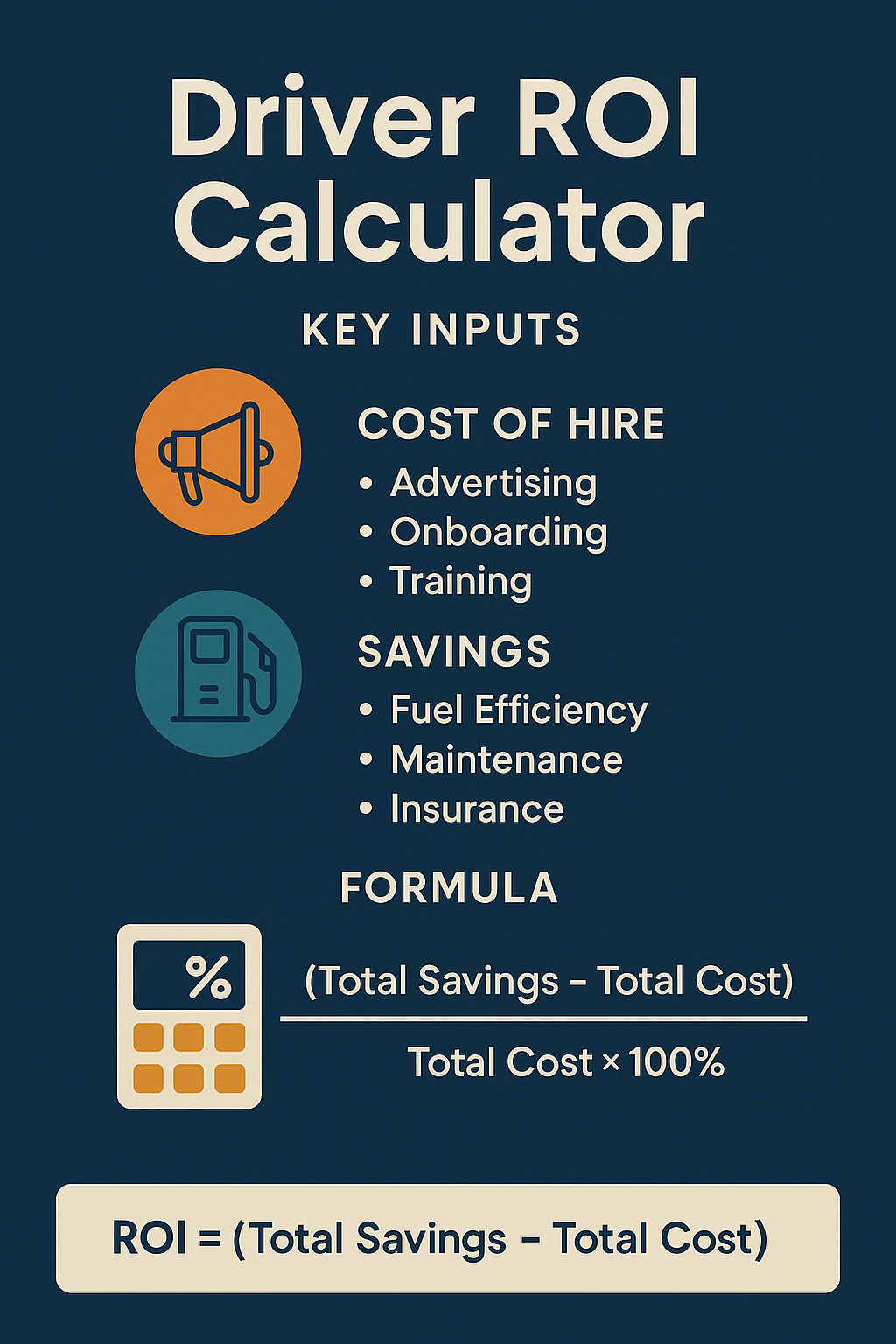
A driver ROI calculator takes into consideration not only the cost but also the savings side. So, the main inputs are:
- Cost of hire: Advertising, recruiter fees, onboarding, training
- Operational savings: Improved fuel efficiency, fewer breakdowns, reduced detention costs
- Retention impact: Lower turnover means less repeated hiring cost
When you enter all these values in a simple formula, the fleet will see at what point exactly their investment is recouped, and how fast the drivers hired later generate the net profit.
Basic ROI Formula

By using this formula with different hires, it will be possible for you to find out the cumulative ROI indicating the worth of a 3-hire ROI strategy.
Creation of a 3-Hire ROI Model

A fleet payback tool with a three-hire forecast is an incredible base for motivating: after three winning drivers, the tool shows fleets reaching positive ROI. Here’s the way to go:
- Cost assumptions
- Advertising and recruiting: $4,000 per hire
- Onboarding and training: $2,000 per hire
- Advertising and recruiting: $4,000 per hire
- Savings estimation per driver
- Fuel efficiency gains: $5,000 yearly
- Lower maintenance and accident costs: $3,000 yearly
- Insurance premium reductions: $2,000 yearly
- Fuel efficiency gains: $5,000 yearly
- Calculating three drivers
| Hire # | Cost of Hire ($) | Annual Savings per Driver ($) | Net Savings ($) | Cumulative ROI |
| 1 | 6,000 | 10,000 | 4,000 | 67% |
| 2 | 6,000 | 10,500 | 4,500 | 75% |
| 3 | 6,000 | 11,000 | 5,000 | 83% |
Table 1: Example of a three-hire ROI calculation
On this model, we can see that by the time the third hire is made, the fleet’s cumulative savings will almost be double the total hiring costs.
Characteristics of a Good Fleet Payback Tool
When it comes to buying or creating the fleet payback tool, you must look for features including:
- Customizable cost inputs: Adjust recruiter fees, training budgets, and the local wage rate
- Dynamic savings assumptions: Change for fuel price variations and maintenance schedules
- Graphical dashboards: Break-even points visualization and tracking ROI over time with graphs
- Scenario analysis: View “what if” scenarios for different driver performances
- Automated reporting: Prepare easy-to-share ROI summaries for stakeholders
A blend of these features makes your ROI tool not only a mere spreadsheet but a real strategic asset.
Case Study: Quick Payback with Three Hires
Take the case of the small-medium fleet that implemented a driver ROI calculator based on this real-world data:
- Recruiting cost: $5,500 per hire
- Onboarding cost: $1,500 per hire
- Average driver savings: $12,000 annually (fuel, maintenance, insurance)
| Hire # | Cost ($) | Savings ($) | Net ($) | Cumulative ROI |
| 1 | 7,000 | 12,000 | 5,000 | 71% |
| 2 | 7,000 | 12,500 | 5,500 | 79% |
| 3 | 7,000 | 13,000 | 6,000 | 86% |
By the third hire, this fleet had achieved an 86% cumulative ROI, meaning that virtually every dollar that got spent on hiring yielded $0.86 in net profit for that one year. Companies like Trucking Talent that provide fleet payback tool modules as part of their offerings help fleets automate these calculations without requiring extremely complex manual spreadsheets.
Top Tips for Maximizing ROI

- Refine cost inputs
Do a monthly review of the recruiting agency’s invoices and onboarding expenses to keep your assumptions accurate. - Track driver performance
Link telematics and compliance data to savings estimates—drivers with better safety records and fuel efficiency yield higher ROI. - Review once a year
Keep your fleet payback tool relevant by updating it with current fuel prices, insurance rates, and maintenance costs. - Incentivize retention
High turnover rates hurt your ROI. Think about offering bonuses or career development programs to incentivize drivers to stay beyond the three-hire break-even point. - Share your findings
Provide 3-hire ROI summaries to executive teams regularly to socialize the business case for further recruiting investment.
Putting ROI into Your Hiring Strategy
An ROI framework brings about a transformation in the recruitment sector from being a cost center to a real profit driver. It’s a simple step-by-step process:
- Check current hiring costs
List all direct and indirect expenses incurred in recruiting three drivers. - Determine categories of savings
Identify the performance improvements that are directly related to the savings—fuel use, idle time, compliance. - Setup the calculator
Enter the audited costs and projected savings into your driver ROI calculator. - Run scenarios
Use both aggressive and conservative savings to see the min/max ROI. - Establish targets
Set an ROI goal (e.g., 50% by the second driver, 80% by the third) to steer the recruiting budget.
Closing Remarks
Hiring the right personnel has increasingly turned out to be a decisive factor in the survival and prosperity of many companies in a highly competitive business environment and in the conditions of a driver’s shortage. The implementation of a fleet payback tool based on the operation of a 3-hire ROI model makes it clearer: quantifying costs, projecting savings, and tracking ROI, fleet managers can make data-discussed recruitment decisions. Whether you are building the driver ROI calculator from scratch or you are using platforms that come with built-in analytics, one thing is very important: you should keep your inputs up to date and share your clear results with the stakeholders. By this way, the simple concept of ROI will be omnipresent tool for both profit and growth.
Driver ROI Calculator: FAQ
1. Core Concepts
1. What is a driver ROI calculator?
A driver ROI calculator is a tool that compares the total cost of hiring (advertising, recruiter fees, onboarding, training) against operational savings (fuel efficiency gains, fewer breakdowns, insurance discounts) to quantify the true profitability of each new driver.
2. How is ROI calculated for fleet hires?
ROI = (Total Savings – Total Cost) ÷ Total Cost × 100%, showing the percentage return on every dollar spent recruiting drivers.
3. What does a 3-hire ROI breakeven mean?
A 3-hire breakeven point is reached when the cumulative net savings from three new drivers exceed the total hiring expenses, confirming that the fleet’s investment is paying off.
2. Enhancing Predictive Accuracy
4. How does integrating telematics and compliance data refine ROI predictions?
Feeding real-time telematics (fuel use, idle time) and safety compliance metrics into your calculator aligns savings estimates with actual driver performance, making projections more accurate.
5. Why are dynamic savings assumptions crucial for reflecting real-world driving conditions?
Dynamic assumptions let you adjust for fluctuating fuel prices and changing maintenance schedules, ensuring your ROI forecasts stay relevant amid market variability.
6. What distinguishes a strategic fleet payback tool from a basic spreadsheet?
Beyond simple calculations, a strategic tool offers customizable inputs, graphical dashboards, scenario “what-if” analyses, and automated reporting—turning data into actionable insights.
3. Maximizing ROI & Case Study
7. How can incentivizing driver retention push ROI beyond the 3-hire breakeven?
Offering retention bonuses or career-development programs lowers turnover-related costs, amplifying net savings once the initial breakeven point is passed.
8. What did Trucking Talent’s case study reveal about rapid ROI payback?
With $5,500 recruiting and $1,500 onboarding costs per hire, and $13,000 average annual savings per driver, the featured fleet achieved an 86 % cumulative ROI by the third hire.